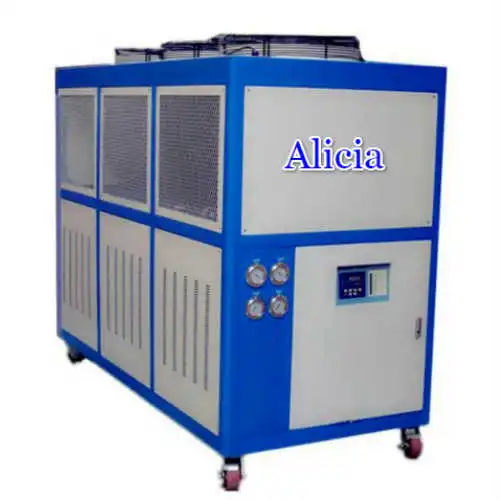
1. Main Applications and Functions of Air Cooled Chillers
air cooled industrial blow molding chillers are used throughout multiple stages of blow molding, providing cooling for different equipment needs.
Mold Cooling: This is the most crucial application. Blow molding molds generate significant heat due to plastic melting and pressure during continuous operation. If not cooled promptly, this can lead to slow bottle cooling, deformation, and uneven wall thickness. Chillers remove this heat from the mold through water circulation, ensuring rapid preform shaping and maintaining dimensional accuracy and a smooth bottle appearance.
Extruder Cooling: In the extrusion blow molding process, the extruder heats and melts the plastic granules. Chillers cool the extruder barrel and screw, preventing localized overheating that could lead to plastic decomposition and carbonization, while also stabilizing melt viscosity and ensuring uniform extrusion volume.
Compressed Air Cooling: Blow molding requires high-pressure air to inflate the preform. The compressed air heats up during compression, and this high temperature affects the preform cooling and setting efficiency. A chiller cools the compressed air, shortening the bottle cooling time and increasing production speed.
2.Specifications:
|
Model
|
Unit
|
AT-5AC
|
AT-6AC
|
AT-8AC
|
|
Cooling Capacity
|
|
KW
|
14.5
|
17.5
|
27
|
|
|
Kcal/h
|
12758
|
15054
|
23220
|
|
Compressor
|
Input Power
|
KW
|
3.75
|
4.5
|
6
|
|
Rated Power
|
HP
|
5
|
6
|
8
|
|
Power
|
|
3PH-380V/50HZ
|
|
Evaporator
|
Type
|
Shell and Tube
|
|
Pie Diameter
|
inch
|
1”
|
1”
|
2”
|
|
Refrigerant
|
Type
|
R22
|
|
Quantity
|
KG
|
2
|
2.5
|
4
|
|
Condenser(air chiller)
|
Type
|
Finned Copper Tube + Low Noise Outer Rotor Fan
|
|
Fan Power
|
W
|
180*2
|
180*2
|
420*2
|
|
Water Tank Capacity
|
|
Liter
|
45
|
45
|
80
|
|
Pump
|
Power
|
KW
|
0.75
|
0.75
|
1.5
|
|
HP
|
1
|
1
|
2
|
|
Distance
|
m
|
35
|
35
|
15
|
|
Flow Rate
|
L/min
|
110
|
110
|
360
|
|
Safety Protection
|
High and Low Pressure Protection, Overload Protection,Overtemperature Protection, Phase Sequence Protection,etc.
|
|
Dimensions(L*W*H)
|
|
mm
|
1280*680*1225
|
1280*680*1225
|
1550*850*1508
|
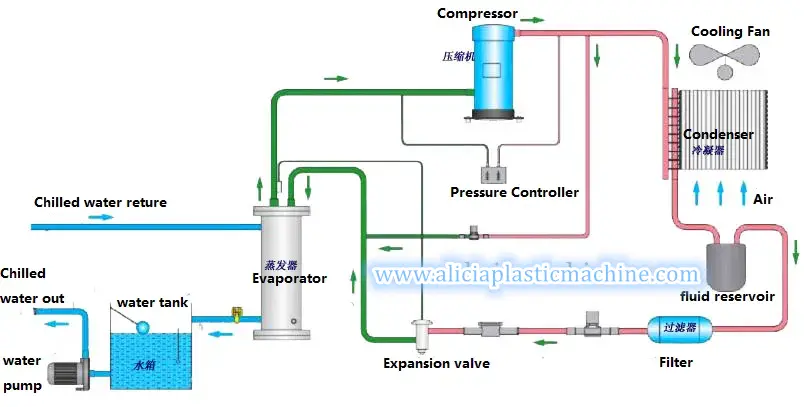
3. Core Working Principle of air cooled blow molding chillers
The chiller's workflow revolves around three steps: "refrigeration - circulation - heat dissipation," providing a stable cold source for the blow molding system.
Refrigeration Cycle: The compressor inside the chiller compresses the refrigerant into a high-temperature, high-pressure gas, which is then sent to the condenser for heat dissipation, becoming a low-temperature, high-pressure liquid.
Heat Exchange: The low-temperature liquid, after being throttled by an expansion valve, enters the evaporator, where it exchanges heat with the circulating water in the system, cooling the water to the set temperature (typically 5-15℃).
Cooling Application: The cooled circulating water is pumped to equipment requiring cooling, such as molds and extruders, where it absorbs heat and returns to the evaporator, completing one cycle.
Choosing a suitable chiller for blow molding production requires comprehensive consideration of multiple factors, including cooling capacity, cooling method, and compressor type. The following are specific selection points:
1.Cooling capacity calculation
Based on clamping force conversion: Blow molding machines are usually labeled with clamping force in "tons." This can be converted to "ounces," and the chiller can be configured based on the empirical value of approximately 0.7 kW of cooling capacity per ounce. For example, a blow molding machine with a clamping force of 600T corresponds to a cooling capacity of approximately 75.1 ounces × 0.7 = 52.57 kW, equivalent to a 15HP chiller.
2.Based on compressed air flow rate: The cooling capacity is precisely calculated based on the compressed air processing flow rate and cooling range. Generally, for compressed air with a processing flow rate of 10 m³/min, reducing the temperature from 40℃ to 2-5℃, the chiller's cooling capacity needs to be no less than 15 kW. Furthermore, the cooling capacity required for preform cooling and mold cooling must also be considered to ensure that the chiller's cooling capacity meets the needs of the entire blow molding production process.
3. Cooling Method Selection:
Air-cooled chillers: Suitable for environments with good air circulation, requiring no additional cooling water source, and are relatively simple to install and maintain. If the blow molding workshop has a large space, good ventilation, and inconvenient or expensive water supply, air-cooled chillers are the preferred choice.
Water-cooled chillers: Offer higher heat dissipation efficiency and more stable operation, suitable for applications requiring high-efficiency cooling. They are typically used in conjunction with cooling towers and are suitable for environments with high heat loads. For large-scale blow molding workshops with high cooling demands and sufficient water supply and space for cooling tower installation, water-cooled chillers are a better choice.
4. Compressor Types:
*Screw compressors: Suitable for medium to large-scale cooling needs, characterized by high efficiency, stability, and long lifespan. For large blow molding production lines with high cooling capacity requirements, screw compressors provide reliable cooling support.
Scroll compressors: Suitable for small and medium-scale cooling needs, offering advantages such as low noise and high energy efficiency. For small blow molding machines or blow molding production scenarios with relatively low cooling capacity requirements, scroll compressor chillers are more suitable.
5. Temperature Control Accuracy: In blow molding production, compressed air needs to be cooled to 2-5℃, and water temperature fluctuations must be controlled within ±0.5℃. Therefore, chillers equipped with a PID intelligent temperature control system should be selected, which can monitor water temperature in real time and automatically adjust to ensure accurate temperature control.
6. Water Quality Requirements: PET bottle production has high water quality requirements. To prevent rust and water contamination, water-contact components of the chiller, such as the evaporator and water tank, should be made of 304 stainless steel. A water softener should also be considered to reduce scale buildup.