Mold dehumidifier for PET preform processing
A mold dehumidifier for PET preform processing is a specialized device that controls moisture in the mold and surrounding environment—a critical function because even trace moisture can cause defects in PET preforms (the intermediate products for plastic bottles). It directly ensures the transparency, structural integrity, and production stability of PET preforms.
Core Role of mold dehumidifier used in PET Preform Processing
PET (polyethylene terephthalate) is highly hygroscopic: it absorbs ambient moisture easily, and when heated during injection molding, this moisture reacts with molten PET to cause hydrolytic degradation. This degradation weakens the material and creates defects like bubbles, haze, or silver streaks on preforms.
The mold dehumidifier solves this by focusing on two key areas:
- Dehumidifying the mold surface: Prevents condensed moisture from forming on the cold mold (when the mold is cooler than the ambient dew point), which would otherwise mix with molten PET and cause surface defects.
- Controlling the local environment: Reduces humidity in the space around the injection mold (usually within a 1–2m radius), stopping PET resin or preforms from reabsorbing moisture before/after molding.
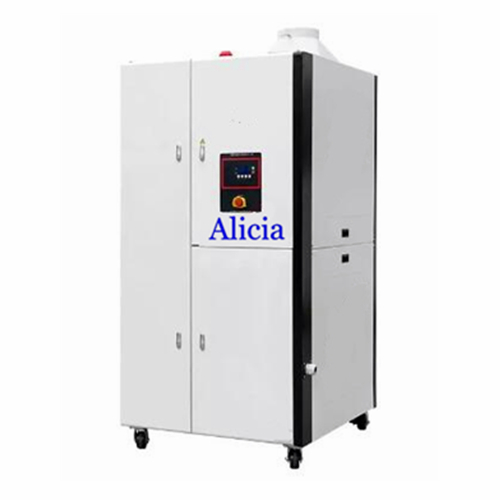
Features
● Adopt liquid crystal display microcomputer controller, with regeneration temperature setting and actual temperature display;
● Adopt honeycomb design to ensure stable output of long-term dehumidification air dryness throughout the year;
● With motor overload and reverse phase alarm function;
● With return air cooling and filtering functions;
● Extend the service life of molds, reduce corrosion, and reduce the ratio of product defects and scrap rates;
● The dry air outlet is equipped with a cooler as standard, which can adjust the air temperature;
● With automatic drainage function, the condensed water can be discharged in time;
● Optional detachable return air collector, which can realize closed cycle application, especially suitable for use in areas with high humidity;
● Optional dew point meter is available for real-time monitoring of dew point.
Working Principle of mold dehumidifier
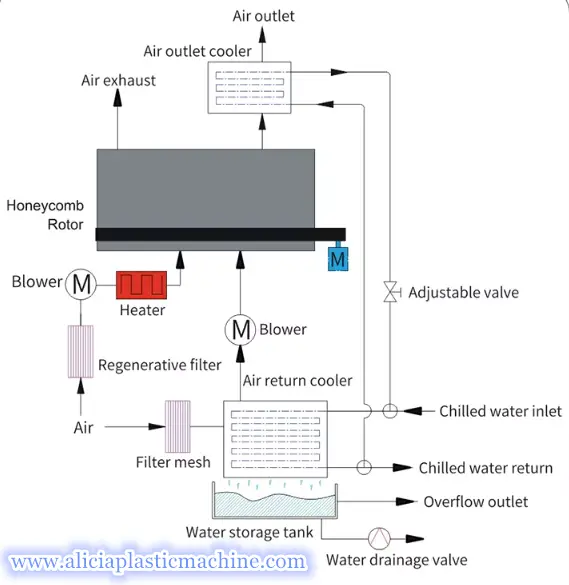
It typically uses a refrigeration dehumidification or adsorption dehumidification core, combined with targeted airflow design to focus on the mold area:
- Moisture absorption: The dehumidifier draws in humid air from the mold’s vicinity. For refrigeration-type models, the air is cooled to below the dew point, causing moisture to condense and drain away. For adsorption-type models, a desiccant (e.g., silica gel) absorbs moisture from the air.
- Dry air supply: The dehumidified dry air (with relative humidity usually controlled below 40%, or even 30% for high-demand scenarios) is blown directly onto the mold surface and surrounding area through a directional air outlet.
- Cycle maintenance: For adsorption models, the desiccant is periodically regenerated (via heating or hot air) to release absorbed moisture, ensuring continuous dehumidification. Most devices also have a humidity sensor to automatically adjust output and maintain stable humidity levels.
Application of mold dehumidifier
The mold dehumidifier provides dehumidified and dry air for small, medium and large molds. Especially suitable for:
● The mold shell of the fast cycle injection molding machine;
● Mould shell of blow molding machine;
● Automation area of mold shell and PET injection molding machine;
The de-dew machine can work with one or more forming machines, just connect the connecting pipes directionally.
Key Advantages of mold dehumidifier used for PET Preform Production
1. Eliminates Moisture-Related Defects, Ensuring Preform Quality
- Prevents hydrolytic degradation of PET: By keeping the mold and local environment dry, it avoids moisture reacting with molten PET during injection, which would otherwise create internal bubbles or surface silver streaks.
- Maintains preform transparency: Moisture-induced haze or cloudiness is eliminated, ensuring the final PET bottles (blown from preforms) meet food-grade transparency requirements (critical for beverages, cosmetics, etc.).
2. Stabilizes Molding Process, Reducing Scrap Rates
- Avoids mold sticking: Condensed moisture on the mold surface can cause molten PET to stick to the mold, leading to deformed preforms or production line halts. Dry mold surfaces ensure smooth demolding.
- Reduces scrap: Without moisture defects, scrap rates (a major cost in PET processing) can be cut by 5%–15%, depending on the original humidity conditions.
3. Protects Mold Equipment, Extending Service Life
- Prevents mold rust: Moisture in the environment can cause oxidation and rust on the mold’s metal surfaces (especially precision cavities and cores). Dry conditions slow down corrosion, reducing mold maintenance frequency and extending its lifespan (molds for PET preforms are high-cost precision tools).
4. Flexible Adaptation to Production Scenarios
- Compact design: Most models are compact and can be mounted near the injection mold (e.g., on the mold frame or nearby stands), without occupying excessive factory space.
- Adjustable humidity: Users can set target humidity levels (usually 30%–50% RH) based on PET grade (e.g., food-grade vs. industrial-grade) or regional climate (higher humidity in tropical areas requires stricter control).


