Silent Injection Molding Machine Side Crusher Features
Low Noise: Utilizing a low-speed design or special soundproofing, such as double-layer stainless steel insulation, the machine operates at low noise levels, minimizing disruption to the production environment.
Excellent Crushing Performance: Equipped with optimized rotor and blade designs, such as stepped rotor blades and SKD-11 blades, the stepped arrangement of the blades significantly enhances cutting power, pulverizing waste into uniform particles.
Safe and Smooth Operation: Equipped with various safety features, such as limit switches and overload protection, the machine utilizes an axial sprocket drive to reduce bearing wear and ensure smooth and reliable operation.
Easy to Operate and Maintain: Its easily removable structure and removable screen facilitate cleaning, color changes, and maintenance, making installation, cleaning, and maintenance easy. Cost saving: waste materials can be crushed and recycled immediately and mixed with new materials, helping injection molding factories save money on raw materials and reduce the stockpiling and turnover of sprue materials.
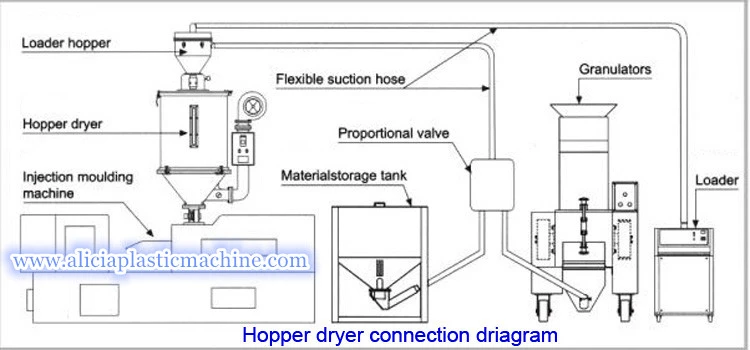
The core operating principle of a silent injection molding machine side crusher is to crush sprue material and plastic waste produced by the injection molding machine into uniform particles through a low-speed, stable mechanical shearing/extrusion action. Its structural design also achieves low noise operation. Specifically, the process can be broken down into four key steps: "feeding - crushing - separation - and discharge." Each step is designed to achieve the dual goals of "quiet" and "efficient crushing":
Core Workflow (using the mainstream low-speed shearing method as an example)
1. Feeding: Directed Feeding to Prevent Material Jamming
Sprue material (such as gate and runner waste) or plastic waste produced by the injection molding machine is fed into the crusher's feed port manually or via a simple conveyor belt (available on some models).
The feed port is typically designed with an inclined guide structure and ample internal space to prevent material accumulation and blockage. Some models are equipped with a "pre-pressing device" (such as a light pressure cover) to press irregular materials toward the crushing area, ensuring smooth feeding and reducing the impact noise caused by material bouncing.
2. Crushing: Low-speed shearing/extrusion for silent crushing (core process)
This is the key difference from conventional high-speed crushers—it doesn't rely on high-speed impact to crush materials. Instead, it uses low-speed, high-torque shearing to pulverize materials, reducing noise at the source. (Due to the high rotor speed, high-speed crushers typically generate noise levels exceeding 80dB due to air friction and material impact, while silent models can keep noise levels below 65dB.) Detailed Process:
Core Component Collaboration: The crushing chamber contains two key components—stationary blades (fixed blades) and rotating blades (rotating blades, mounted on the rotor). The fixed blades are fixed to the inner wall of the crushing chamber, while the rotating blades rotate with the rotor at a low speed (typically 180-300 rpm, much lower than the 800-1500 rpm of high-speed crushers). Shearing and Crushing Process: Once the material enters the crushing chamber, the rotating rotor blades and the fixed fixed blades create a "scissor-like shearing action," gradually shearing and tearing the material. For harder plastic parts (such as thick-walled scrap), some models feature "extrusion bosses" on the rotor that cooperate with the inner wall of the crushing chamber to assist in crushing, ensuring that the material is crushed to the target particle size and preventing "flying" or "blade jamming."
Quiet Design Details: The rotor utilizes a "balanced counterweight design" to reduce vibration and noise during high-speed rotation. The inner wall of the crushing chamber is typically coated with soundproofing cotton or a double-layer stainless steel soundproofing structure to further absorb mechanical noise generated during the crushing process.
3. Separation: Screening to Ensure Uniform Particle Size
The crushed material is then screened (filtered) to ensure uniform particle size, allowing for subsequent mixing with new material for reuse. The screen is installed at the bottom of the crushing chamber, parallel to the rotor. The pulverized material is flung toward the screen by the rotor. Particles that meet the required particle size pass through the screen holes and fall into the receiving bucket/conveyor belt below. Larger particles that do not meet the required particle size remain in the crushing chamber and undergo further shearing by the passive and fixed blades until they meet the required size.
The screen is typically designed with a removable structure, allowing for easy replacement of different apertures (e.g., 10mm, 15mm) to meet the recycling requirements of different injection molded products.
4. Discharge: Stable Output for Easier Recycling
Qualified particles that pass through the screen naturally fall through the discharge port into the corresponding receiving bucket, suction machine, or conveyor belt, and are directly transported to the injection molding machine's raw material mixing system (some models support "instant recycling"). This creates a closed loop of "injection molding - waste crushing - recycling and reuse," reducing raw material waste. The discharge port is usually designed with an "inclined anti-blocking structure" to prevent particle accumulation; some models will be equipped with a "silent fan" at the discharge port to assist in discharging while reducing the collision noise when the particles fall.
Silent Injection Molding Machine Side Crusher Core Application
1. Instant Crushing and Recycling of Injection Molding Machine Sprue Material
In injection molding production, every product generates sprue material (i.e., molding waste such as gates, runners, and sprues, accounting for 5%-20% of the total raw material volume). Traditionally, sprue material must be collected and transported to a crushing plant. This not only incurs transportation costs but also can reduce recycling rates due to moisture and contamination. The silent, on-site crusher can be installed directly next to the injection molding machine (usually 1-3 meters away). After removing the sprue material from the injection molding machine, it can be directly fed into the crusher without any handling. The crushed particles (typically 5-20mm in size, adjustable via a screen) can be reused in two ways:
Direct Reuse: The crushed particles are conveyed directly back to the injection molding machine hopper via a suction machine and mixed with fresh material in a proportional manner (usually 10%-30%, depending on product requirements), completing a closed-loop "production-crushing-reuse" cycle without the need for additional transportation or storage.
Temporary Reuse: The crushed particles fall into a receiving drum for temporary storage. Once a certain amount accumulates, they are mixed with fresh material. This method is suitable for products requiring high raw material purity (such as food-grade plastic parts and transparent parts).
Typical applications include: home appliance plastic parts (such as washing machine panels and air conditioner housings), daily necessities (such as plastic cups and storage boxes), and automotive small parts (such as clips and wiring harness fasteners).
2. Crushing and Recycling Injection Molding Defective Products/Trial Mold Scrap
Injection molding inevitably produces defective products (such as missing material, flash, and deformed parts) or trial mold scrap (test pieces produced during new product trials, typically in small batches but with high raw material costs). This type of scrap is large (e.g., complete appliance housings), making it difficult for ordinary small crushers to handle. However, silent on-press crushers (especially those with a feed opening ≥200mm) can crush the scrap directly, eliminating the storage space issues associated with large waste volume. For example, scrap generated during automobile bumper trial molds (up to 1-2 meters in length) can be crushed in sections using a silent crusher with a large feed opening. The crushed particles can then be reused in the production of non-exterior parts (such as internal bumper reinforcement ribs), significantly reducing trial mold costs.
3. "Crushing as you go" for small-batch continuous production
Some injection molding shops utilize a multi-machine, small-batch production model (e.g., simultaneous production of connectors and fasteners of various specifications). Each product has a small amount of sprue material but a wide variety of materials. Centralized crushing can easily lead to color mixing/mixing of materials (e.g., red sprue material mixed with white particles). Silent on-press crushers can be used for either one machine or two adjacent injection molding machines, individually crushing sprue material of different colors and materials to avoid the risk of material mixing. This is particularly suitable for applications requiring high material purity, such as electronic plastic parts (e.g., connectors and terminals) and medical consumables (e.g., disposable plastic accessories, where cross-contamination is crucial).


