How are water chillers used in the plastic blow molding industry?
This question accurately addresses the crucial issue of "temperature control" in blow molding production. Water chillers are not directly involved in the blow molding process, but rather address the high-temperature issues associated with production through stable, low-temperature water circulation.
1. Main Applications and Functions
Water chillers are used throughout the blow molding process, before, during, and after, providing cooling tailored to the needs of different equipment.
Mold cooling: This is the most critical application. During continuous operation, blow molding molds generate significant heat due to the molten plastic and pressure. If not cooled promptly, the bottle will cool slowly, deform, and have uneven wall thickness. Water chillers remove heat from the mold through water circulation, ensuring that the preform can quickly set its shape and maintaining dimensional accuracy and a smooth appearance.
Extruder cooling: In the extrusion blow molding process, the extruder heats and melts the plastic pellets. Chillers cool the extruder's barrel and screw, preventing localized overheating that can lead to plastic decomposition and carbonization. They also stabilize melt viscosity and ensure uniform extrusion output.
Compressed Air Cooling: Blow molding requires high-pressure air to inflate the preform. Compressed air heats up during the compression process, and high-temperature air can affect the efficiency of preform cooling and shaping. Chillers cool the compressed air, shortening bottle cooling time and increasing production speed.
2. Core Working Principle
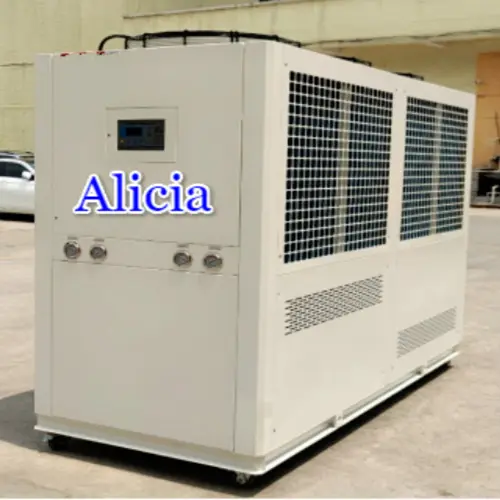
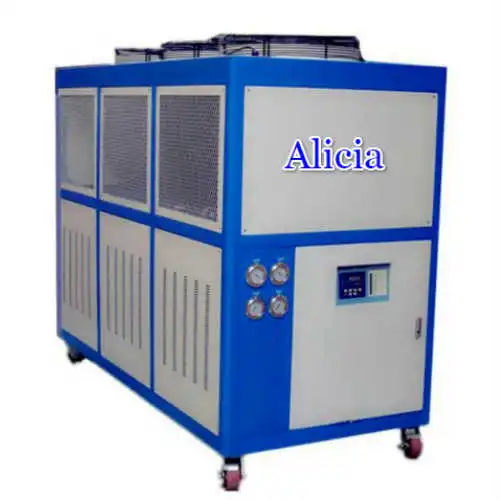
The chiller's workflow is based on a three-step process: "refrigeration - circulation - heat dissipation," providing a stable cooling source for the blow molding system.
Refrigeration Cycle: The compressor inside the chiller compresses the refrigerant into a high-temperature, high-pressure gas, which is then sent to the condenser for heat dissipation, transforming into a low-temperature, high-pressure liquid.
Heat Exchange: After being throttled by the expansion valve, the low-temperature liquid enters the evaporator, exchanging heat with the circulating water in the system, cooling the water to the set temperature (typically 5-15°C).
Cooling Application: The cooled circulating water is pumped to equipment requiring cooling, such as the mold and extruder. After absorbing heat, it returns to the evaporator, completing the cycle.
3. Selection and Usage Key Points
Choosing the right chiller is crucial for ensuring optimal blow molding results. Focus on the following two key points:
Cooling Capacity Matching: Determine the chiller's cooling capacity based on the blow molding machine's specifications (e.g., single-cavity/multi-cavity), production speed, and mold size. Insufficient cooling capacity results in poor cooling performance, while excessive cooling wastes energy.
Water Temperature Stability: Blow molding requires high water temperature accuracy (typically within ±1°C). It's recommended to choose a chiller with an intelligent temperature control system to prevent water temperature fluctuations from affecting product quality.

 Why are closed-circuit cooling towers needed to make cheese?
 closed-circuit cooling tower systems for process cooling applications
 How are chillers used in the cosmetics manufacturing industry?
 How are water chillers used in the detergent manufacturing industry?


