The core functions of industrial water chillers in the cosmetics industry are precise temperature control, rapid cooling, and constant temperature preservation, covering four major stages: emulsification/reaction, extraction, filling, and equipment cooling. These directly determine product activity, stability, and production efficiency.
I. Working Principle (Simplified Version)
industrial water chillers use a vapor compression cycle (compressor → condenser → expansion valve → evaporator) to cool water to 5–35℃ (commonly 20–30℃). The circulating water carries away heat from the reaction vessel/emulsification tank/piping, achieving high-precision temperature control of **±0.3–1℃**.
II. Four Core Application Scenarios
1. Emulsification/Reaction Vessel Temperature Control (Core of Creams/Essences/Lotions)
Scenario: Vacuum emulsification pots, reaction vessels (50–2000L). Emulsification requires homogenization at 70–85℃, followed by rapid cooling.
Temperature Standards:
Face Cream: 25±1℃
Essence: 22±1℃
Lotion: 28±1℃
Functions:
Prevents deactivation of active ingredients (e.g., hyaluronic acid, vitamin C)
Avoids layering, clumping, and discoloration of the cream
Shortenes cooling time (e.g., from 80℃ to 25℃, completed in 2–3 hours, increasing efficiency by 3–5 times)
2. Low-Temperature Extraction (Plant Essential Oils/Active Extracts)
Scenario: Extraction of heat-sensitive raw materials such as rose, lavender, and centella asiatica.
Temperature: **≤30℃** Low-temperature extraction protects aromatic substances and antioxidants.
Effects: Purer aroma and higher activity of essential oils, avoiding damage from high temperatures.
3. Filling/Pipeline Temperature Control (Creams/Lotions/Aqueous Products)
Scenario: Heat generated during long-term operation of filling machine hoppers, conveying pipelines, and metering pumps.
Temperature: Constant temperature of 5–30℃, temperature control accuracy ±0.3℃.
Functions:
Ensure accurate filling volume (temperature fluctuations can alter viscosity)
Prevent product deterioration, stratification, and air bubbles within the pipeline
Protect pump body/seals, extending lifespan
4. Equipment/Workshop Auxiliary Cooling
Cooling of the stirring motor, homogenizing head, and pump body to prevent overheating and burnout.
Local temperature control in cleanrooms to stabilize the production environment.
III. Selection Considerations (Cosmetics Industry)
Type: Air-cooled chiller(no cooling tower required, preferred for cleanrooms); Water-cooled (for large factories with high cooling capacity).
Temperature Control Range: 5–35℃, accuracy within ±0.5℃.
Material: 304/316 stainless steel piping and water tank, conforming to GMP food and pharmaceutical grade standards.
Cooling Capacity: Calculated based on emulsification kettle volume × temperature rise × specific heat capacity (e.g., approximately 30kW is required for a 500L kettle from 80℃ to 25℃). IV. Common Configuration Reference
Small Production Line (50–500L reactors): 5–15kW air-cooled industrial water chiller, temperature control 20–30℃.
Medium Production Line (1000–2000L reactors): 20–50kW water-cooled industrial water chiller, multiple reactors connected in parallel.
V. Summary
The industrial water chiller is the "temperature control heart" of cosmetic production: protecting activity, stabilizing texture, improving efficiency, and complying with GMP. Without it, the activity and stability of high-end serums and creams cannot be guaranteed, and large-scale production is impossible.



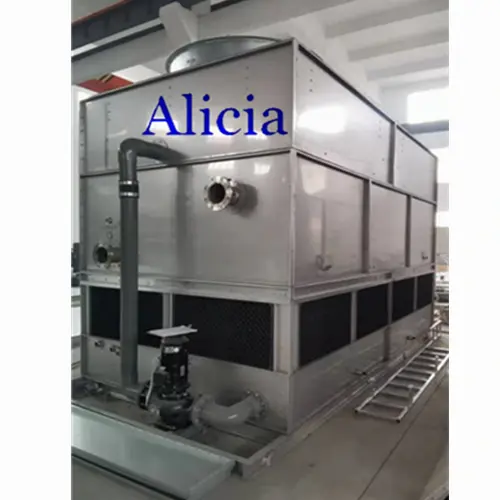 Why are closed-circuit cooling towers needed to make cheese?
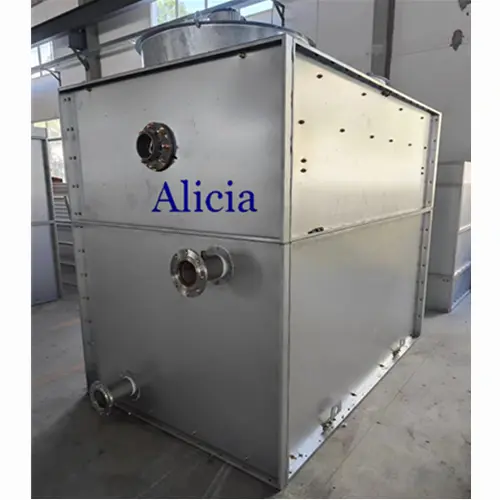 closed-circuit cooling tower systems for process cooling applications
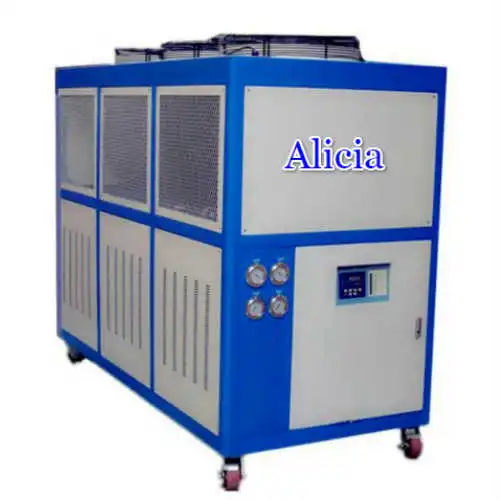 How are water chillers used in the detergent manufacturing industry?
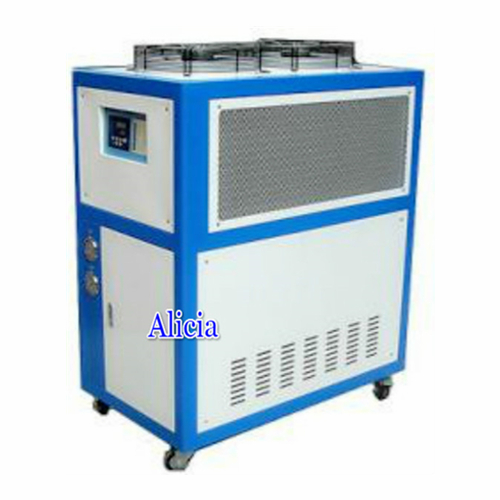 How are water chillers used in the soap manufacturing industry?


