In the manufacturing process of industrial floor grating, industrial water chillers and industrial cooling towers are mainly used to cool related equipment and processes. The specific functions are as follows:
Extruder cooling: During the extrusion molding process of industrial floor grating, the screw and barrel of the extruder will generate a lot of heat due to the friction of the material and the motor drive. If the temperature is too high, the performance of the plastic raw material will change, such as reduced viscosity and decreased thermal stability, which will affect the quality of the grating substrate and cause problems such as dimensional instability and surface roughness. The industrial water chillers cools the screw and barrel of the extruder by circulating cold water, accurately controls its temperature, and plasticizes and extrudes the plastic raw material under stable temperature conditions, ensuring the quality stability and dimensional accuracy of the grating substrate.
Mold cooling: The mold will heat up due to contact with high-temperature plastic during injection molding or extrusion. Excessive mold temperature will slow down the cooling of the plastic, extend the molding cycle, and reduce production efficiency; at the same time, it may also cause defects such as uneven shrinkage and deformation of the grating product. The low-temperature cooling water provided by the industrial water chillers circulates in the cooling channel of the mold, which can quickly take away the heat of the mold, keep the mold within the appropriate temperature range, speed up the cooling and shaping speed of the plastic, shorten the molding cycle, improve production efficiency, and help obtain grating products with high dimensional accuracy and good surface quality.
Cooling of other equipment: During the manufacturing process, such as printing equipment, surface treatment equipment, etc., heat may also be generated during operation, affecting the normal operation and service life of the equipment. The industrial water chillers can provide cooling for these equipment to ensure that they operate at a stable operating temperature, improve the reliability and stability of the equipment, and reduce failures and downtime caused by overheating of the equipment.
industrial cooling towers are usually used in conjunction with industrial industrial water chillerss, mainly used to cool the circulating cooling water in the industrial water chillers. During the operation of the industrial water chillers, its refrigeration system transfers the heat in the circulating cooling water to the refrigerant, and then dissipates the heat to the external environment through the condenser. The industrial cooling tower cools the hot water that has absorbed heat in the condenser, lowers its temperature, and then returns it to the industrial water chillers for circulation. Specifically, hot water flows out of the condenser of the industrial water chillers and is transported to the top of the industrial cooling tower, and is evenly sprinkled on the packing in the industrial cooling tower through the spray device. At the same time, the fan at the bottom of the industrial cooling tower draws external air into the tower, and the air and the falling hot water are fully in contact on the surface of the packing for heat exchange. Part of the heat in the hot water is transferred to the air through evaporation, which reduces the temperature of the hot water. The cooled water is collected in the water collection tank at the bottom of the industrial cooling tower, and then sent back to the condenser of the industrial water chillers by the cooling water pump for continued circulation cooling. Through the function of the industrial cooling tower, it can be ensured that the circulating cooling water of the industrial water chillers has a good cooling effect, thereby ensuring that the industrial water chillers can continuously and stably provide low-temperature cooling water source for industrial floor grating manufacturing equipment.
In the industrial floor grating manufacturing process, the specific cooling process of the industrial water chillers and industrial cooling tower is as follows:
Cooling process of industrial water chillers
Refrigeration cycle: The compressor in the industrial water chillers compresses the refrigerant into high-temperature and high-pressure gas, and then sends it to the condenser. In the condenser, the refrigerant exchanges heat with the cooling water, releasing heat and cooling into liquid. The liquid refrigerant enters the evaporator through the expansion valve, evaporates in the evaporator and absorbs heat, which reduces the temperature of the chilled water in the evaporator.
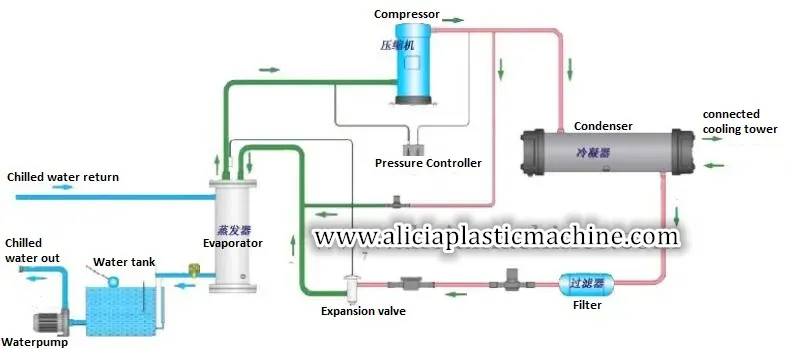
Chilled water circulation: The chilled water pump extracts low-temperature chilled water from the evaporator of the industrial water chillers and transports it through pipes to the equipment that needs to be cooled, such as extruders, molds, etc. The chilled water absorbs heat in these equipment and the temperature rises, and then returns to the evaporator of the industrial water chillers to be cooled again, forming a closed cycle.
Cooling process of industrial cooling tower
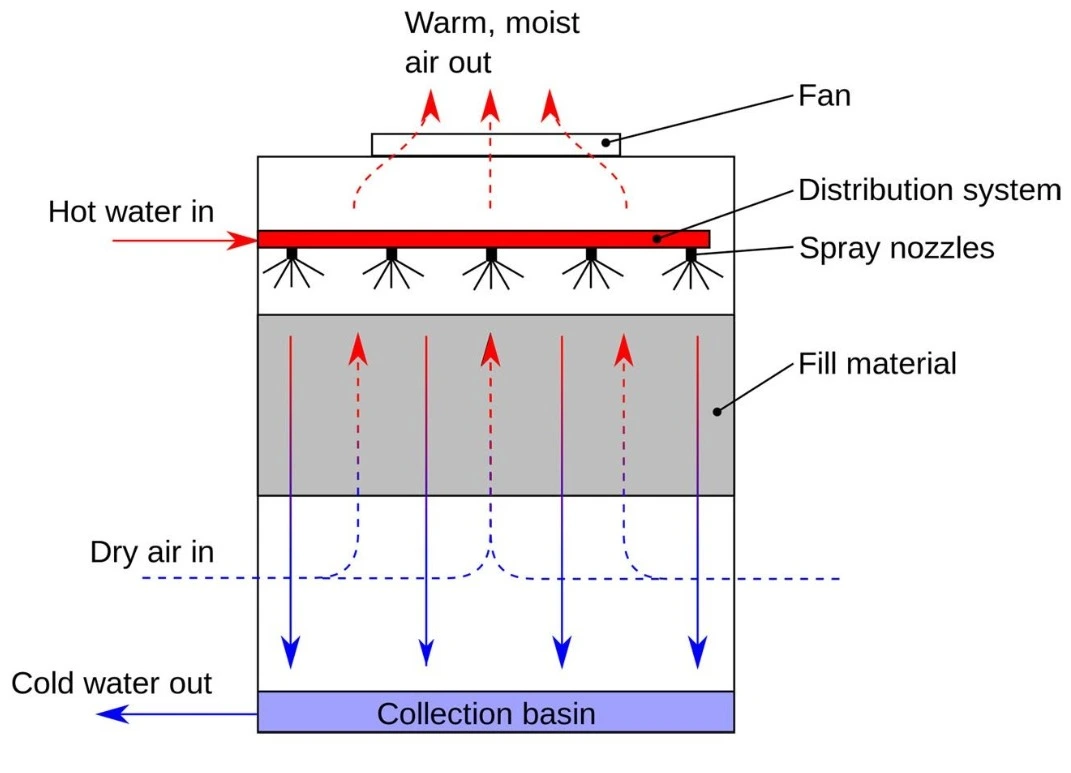
Hot water supply: The cooling water pump extracts hot water that has absorbed the heat of the industrial water chillers condenser from the industrial water chillers and transports it to the top of the industrial cooling tower through pipes.
Spray heat dissipation: The hot water is evenly sprinkled on the packing in the industrial cooling tower through the spray device at the top of the industrial cooling tower to form a water film.
Heat exchange: At the same time, the fan at the bottom of the industrial cooling tower draws external air into the tower, and the air and the falling hot water are fully in contact on the surface of the packing for heat exchange. Part of the heat in the hot water is transferred to the air through evaporation, which reduces the temperature of the hot water.
Cold water return: The cooled water is collected in the water collection tank at the bottom of the industrial cooling tower, and then sent back to the condenser of the industrial water chillers by the cooling water pump to continue the circulation cooling.


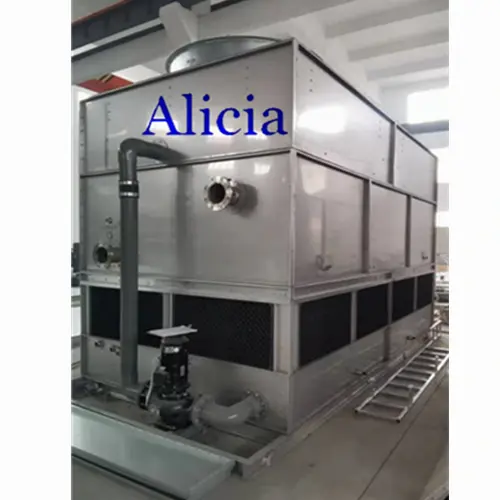 Why are closed-circuit cooling towers needed to make cheese?
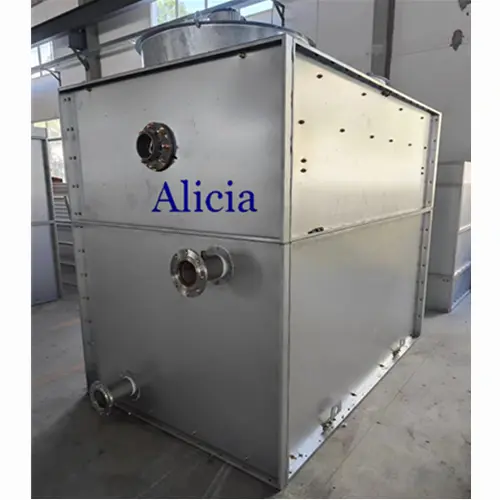 closed-circuit cooling tower systems for process cooling applications
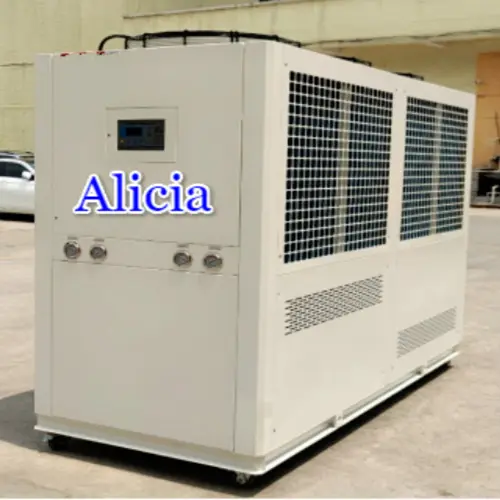 How are chillers used in the cosmetics manufacturing industry?
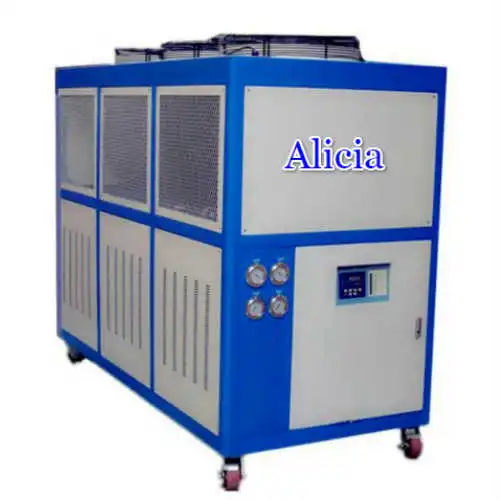 How are water chillers used in the detergent manufacturing industry?




