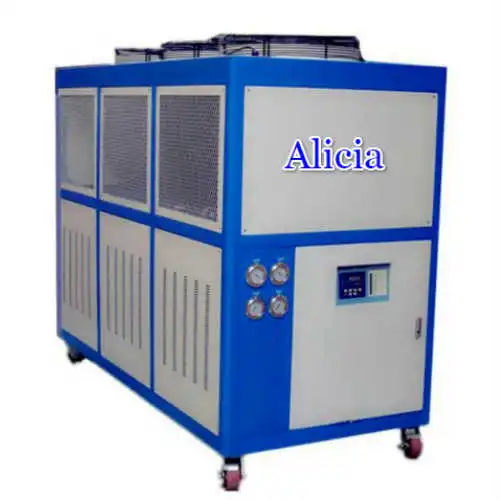
What are the differences between placing the fan on the top and side of a 2hp air-cooled chiller?
The main differences between placing the fan on the top and side of a 2hp air-cooled chiller lie in core dimensions such as heat dissipation efficiency, installation space, maintenance convenience, and environmental adaptability. Specific differences are as follows:
1. Heat Dissipation Efficiency and Airflow Organization
Top fans follow the natural convection principle of "hot air rising," allowing hot air generated by the condenser to be directly exhausted upwards, preventing heat buildup around the equipment and resulting in a smoother heat dissipation path. This is especially suitable for small spaces or scenarios with multiple devices densely packed together, reducing the impact of hot air backflow on cooling efficiency. However, top airflow is easily restricted by overhead obstructions (such as ceilings or ductwork). If the height is insufficient, hot air will be blocked and backflow will occur, actually reducing the cooling effect.
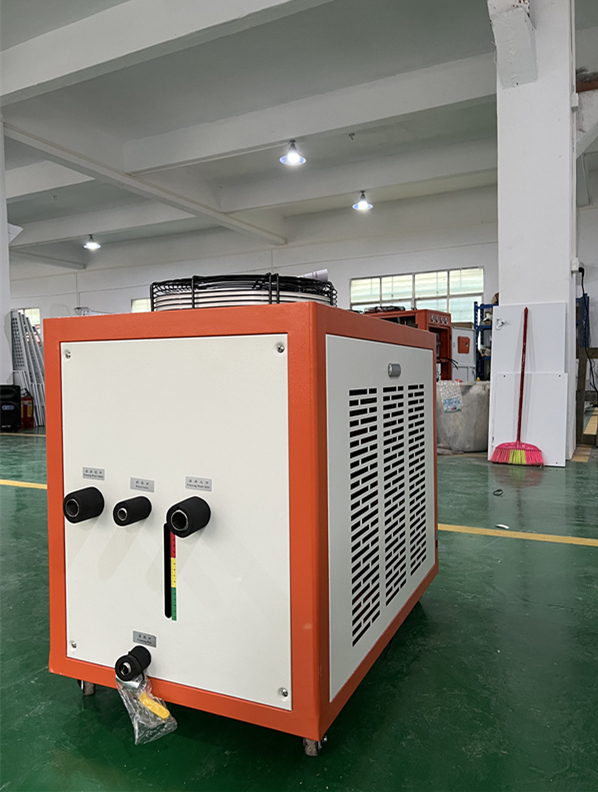
Side fans, on the other hand, have a horizontal airflow, diffusing hot air to the sides of the equipment. They require less overhead height but are easily affected by obstructions on the sides (such as walls or other equipment). If the side fan is too close to the wall (less than 30cm), hot air will backflow to the condenser inlet, causing the condenser temperature to rise and the cooling capacity to decrease. Side fans can optimize heat dissipation by properly planning the direction of the air outlet (e.g., towards an open area), making them suitable for installation environments with many overhead pipes or low ceilings.
2. Installation Space Requirements
Top fans require at least 50-80cm of unobstructed space above the ceiling for hot air exhaust and future maintenance (e.g., cleaning the condenser, servicing the fan). They have higher vertical height requirements and are not suitable for low-ceilinged spaces such as basements or under suspended ceilings. However, the sides of the unit can be close to walls or other equipment, requiring less lateral space, making them suitable for long and narrow installation areas.
Side fans have lower ceiling space requirements (only requiring 20-30cm for maintenance), but require 40-60cm of ventilation space on each side. The air outlet cannot be directly facing a wall or heat source, requiring more lateral space. They are suitable for scenarios with limited ceiling height but open space on both sides.
3. Ease of Maintenance
The top-mounted fan's condenser and fan assembly are located at the top. Routine cleaning (such as blowing away dust) and fan motor replacement require a ladder or platform, making operation slightly more difficult. Furthermore, dust and debris (such as fallen leaves) easily accumulate at the top, requiring more frequent cleaning; otherwise, the air ducts can become clogged.
The side-mounted fan's condenser and fan are side-mounted, allowing for cleaning and maintenance while standing. Maintenance is more convenient, and dust accumulates more slowly on the sides, reducing maintenance frequency.
4. Environmental Adaptability
Top-mounted fans are suitable for indoor environments with low dust levels and open ceilings (such as pharmaceutical workshops and laboratories), or outdoor environments where there is no falling debris. In dusty or oily environments, the top air ducts are prone to clogging, requiring the installation of dust filters. In low-temperature winter environments, the top allows for rapid heat dissipation, reducing the likelihood of abnormal unit start-up and shutdown due to low ambient temperatures.
Side fans are suitable for industrial environments with overhead pipes/obstacles and high dust levels (such as plastic processing plants and hardware workshops). The side dust filters are easier to remove and clean. However, when used outdoors, the side air outlets are susceptible to rain and strong winds, requiring rain covers. Furthermore, in winter, cold air can blow directly onto the condenser, potentially causing low condensing pressure, necessitating freeze protection.
5. Noise Propagation Direction
Top fans primarily transmit noise upwards, having less impact on people in the surrounding horizontal direction. They are suitable for scenarios sensitive to ground noise (such as server rooms next to offices).
Side fans diffuse noise horizontally to the sides. If the equipment is close to a work area, soundproofing measures (such as installing soundproof covers) are required. They are suitable for industrial workshops located away from personnel activity areas.
Selection Recommendations: If the installation site has ample vertical height, narrow side space, and high requirements for ground noise control, top fans are preferred. If the site has limited ceiling height, open sides, or requires frequent maintenance, side fans are preferred.
Does placing the fan on the top or side of an air-cooled chiller significantly affect its cooling performance?
The impact of fan placement (top/side) on cooling performance in an air-cooled chiller is not absolute, but rather strongly related to the installation environment. In suitable scenarios, the impact is minimal, while in constrained environments, the difference is significant, as detailed below:
I. Ideal Installation Environment: Minimal Impact
If both layouts meet minimum ventilation space requirements (≥50cm top space for the top fan, ≥30cm unobstructed side space for the side fan), and the workshop has good airflow and no heat source interference:
The top fan, relying on the natural upward flow of hot air, exhausts hot air more smoothly, resulting in a condensing temperature 2-3℃ lower and a cooling capacity reduction rate of <3%;
As long as the side fan's lateral exhaust is unobstructed, the condensing temperature is similar to the top layout, and the difference in cooling capacity can be controlled within 5%, with no significant impact on actual use.
II. Significant Differences in Restricted Installation Environments
Top Fan Installations: In scenarios with insufficient ceiling height or enclosed ceilings, if the ceiling space is <30cm or obstructed by suspended ceilings or ductwork, hot air cannot be effectively exhausted, leading to "heat recirculation." This causes the condenser temperature to rise by 5-8°C, cooling capacity to decrease by 10-15%, and may even trigger high-pressure alarms or unit shutdown.
Side Fan Installations: In narrow corners or wall-mounted scenarios, if the side distance from the wall is <20cm or the unit is located in a corner of the workshop, hot air accumulates around the unit and recirculates back to the air inlet. This causes the condenser temperature to rise by 6-10°C, cooling capacity to decrease by 15-20%, and compressor power consumption to increase by 8-12%, resulting in a significant drop in operating efficiency.
III. Additional Impacts Under Special Environments
Dusty/High-Temperature Environments
Top Fan: Hot air diffuses upwards, making it less likely for dust to adhere to the condenser, resulting in more stable heat exchange efficiency and a long-term cooling effect reduction of less than 5%.
Side Fan: Condensers are prone to dust accumulation and blockage. If not cleaned in time, heat exchange efficiency will decrease by 10%~15% within 1~2 months, significantly worsening the cooling effect.
Multiple Units Densely Placed Scenarios
Top Fan: Vertical exhaust does not interfere with the air intake of adjacent units, and the cooling effect remains stable even when multiple units are running simultaneously.
Side Fan: Horizontal exhaust easily creates hot air crossflow between units, increasing the overall condensing temperature by 3~5℃ and reducing the cluster cooling efficiency by 8%~10%.


 Why are closed-circuit cooling towers needed to make cheese?
 closed-circuit cooling tower systems for process cooling applications
 How are chillers used in the cosmetics manufacturing industry?
 How are water chillers used in the detergent manufacturing industry?



